Designing and evaluating a custom Value Proposition Canvas: A Case Study of F-Secure Corporation
Context
Company: F-Secure Corporation, University of Eastern Finland
Role: Service Designer, Master Student
Team involved: Design Function, Direct Business, Technology
Duration: August 2024 - May 2025
Tools:Figma
As part of my Master’s thesis, I worked with F-Secure Corporation on a real organizational challenge: how to better support customer-centric solution discovery in a complex B2B2C setting.
The outcome was a custom Value Proposition Canvas, designed, tested, and refined through real co-creation workshops inside the company.
The thesis documents the full research process, design decisions, and evaluation in detail and can be accessed here:
Thesis Publication
The Challenges
F-Secure Corporation, a Finnish cybersecurity company, has long operated in both B2C and B2B2C markets. While technically robust and innovation-focused, F-Secure historically followed a product-centric approach.
Decision-making was often driven by internal goals, technical feasibility, and partner feature requests, rather than end-user insights.
In B2B2C contexts, especially, consumer needs were mediated through partners who frequently lacked a deep understanding of their own customers.
This led to a fragmented understanding of consumer experiences, reduced visibility into pain points, and solution development that struggled to reflect actual customer needs.
Even when consumer insights were available, internal blockers or “pressures” often prevented teams from responding meaningfully to them.
F-Secure’s strategic vision to become the "#1 security experience company in the world" required a shift from product-centricity to customer-centricity (F-Secure, n.d.).
However, in a B2B2C environment with limited consumer visibility and partner-driven constraints, this transformation was far from straightforward.
This thesis set out to explore whether a service design tool — a customized Value Proposition Canvas — could support teams during early solution discovery and help operationalize customer-centricity in a more structured way.
The primary users of the Canvas were internal cross-functional teams responsible for creating consumer-facing services. The intended beneficiaries were consumers globally, often reached via partners in B2B2C delivery models.
The Approach
Project Context & Process Structure
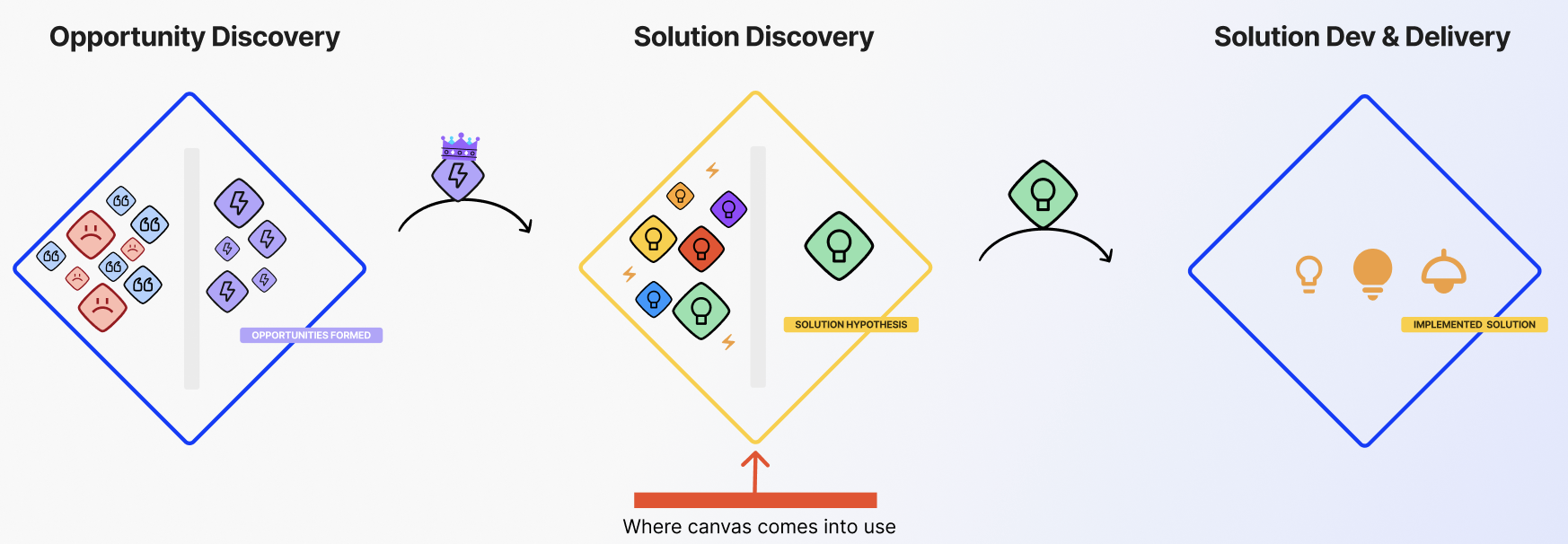
At F-Secure, the Triple Diamond design process has been gradually introduced to support the company’s strategic transition from product-centricity to customer-centricity. This model extends the classic Double Diamond by introducing a strategic front-end phase (Charak, 2020).
At F-Secure, these three diamonds are:
2. Solution Discovery – framing and shaping a solution concept
3. Solution Development and Delivery – executing the solution into production
The Canvas was primarily applied and evaluated in Diamond 2, but its design was informed by insights from Diamond 1 and extended to support the transition into Diamond 3 partially.
The goal was to create a tool that brings clarity, structure, and cross-functional alignment to early solution definition, especially in F-Secure’s complex B2B2C setting.
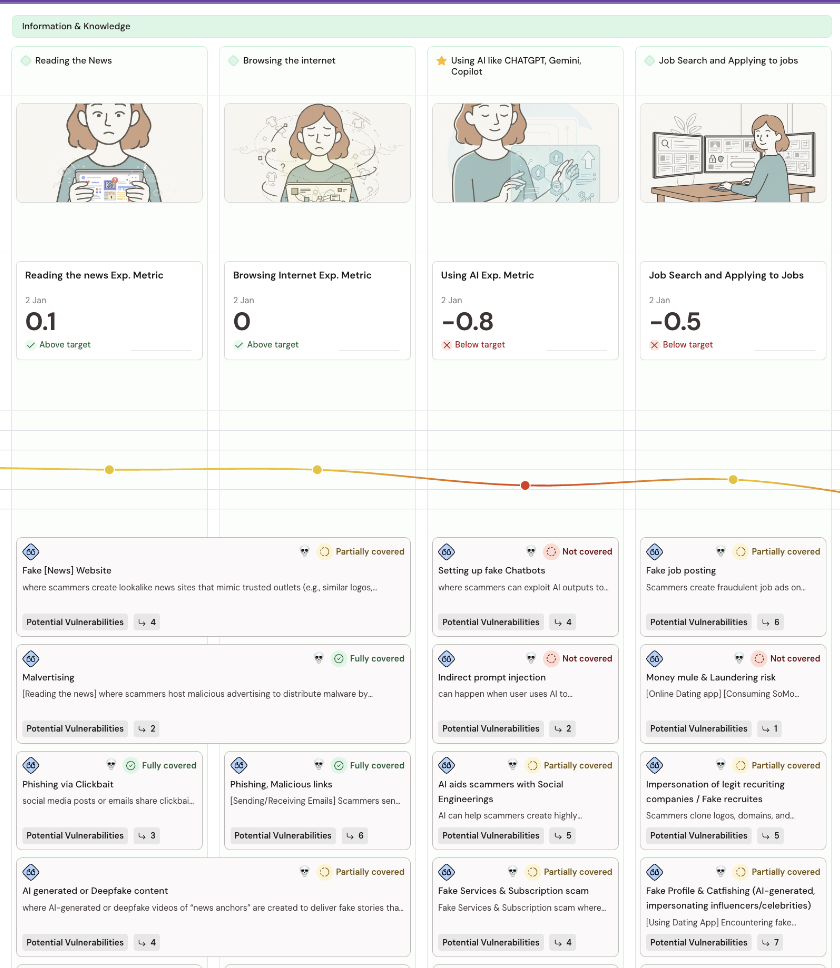
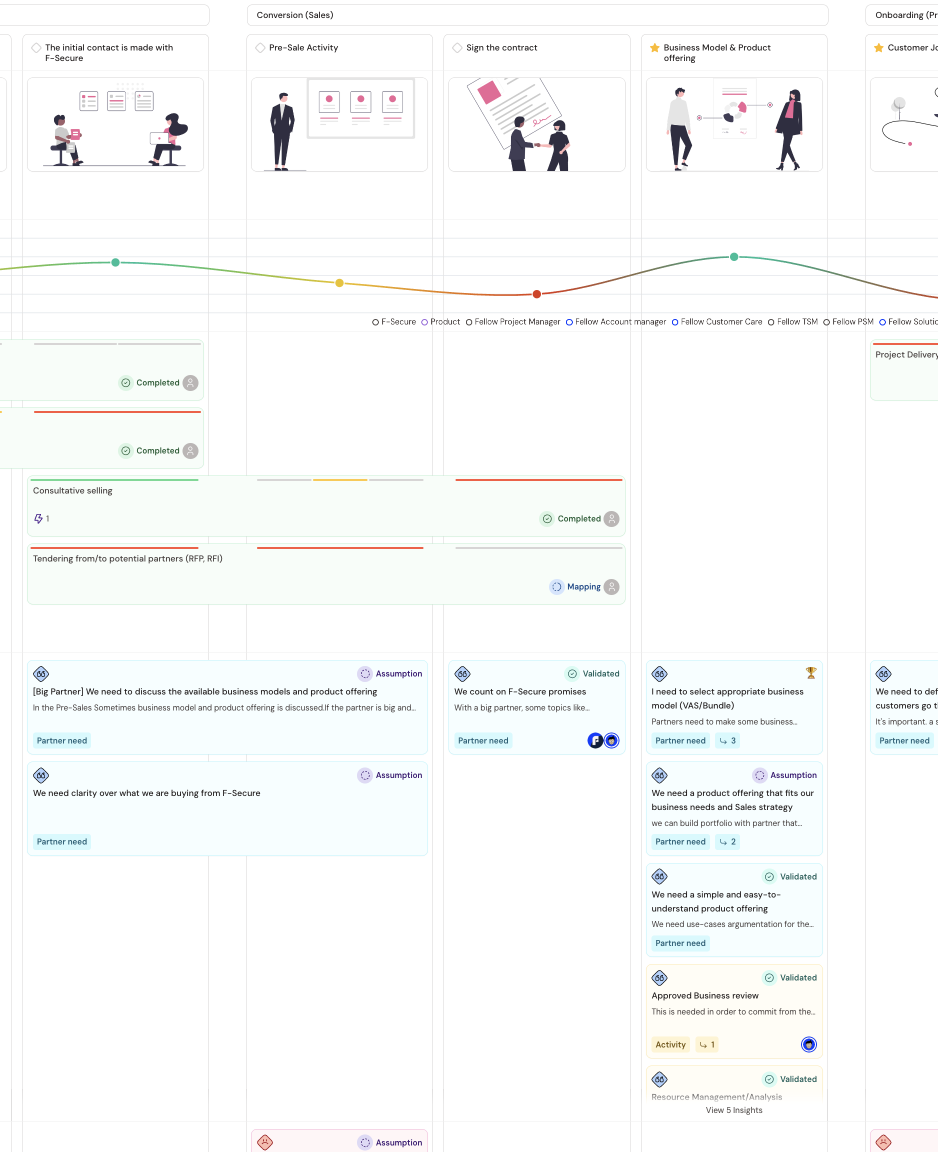
An overview of Triple Diamond [Note: Some visual elements in this document (such as icons for opportunities, solutions, and insights) follow the visual system used in TheyDo.
As this is a tool commonly used at F-Secure, these were included for visual consistency across internal materials.]
Research and Insight Gathering
The Canvas emerged from a hands-on, iterative process rooted in everyday practice rather than formal user research. Its development was informed by ongoing collaboration, co-creation workshops, and reflection sessions within the Design Function and adjacent teams at F-Secure.
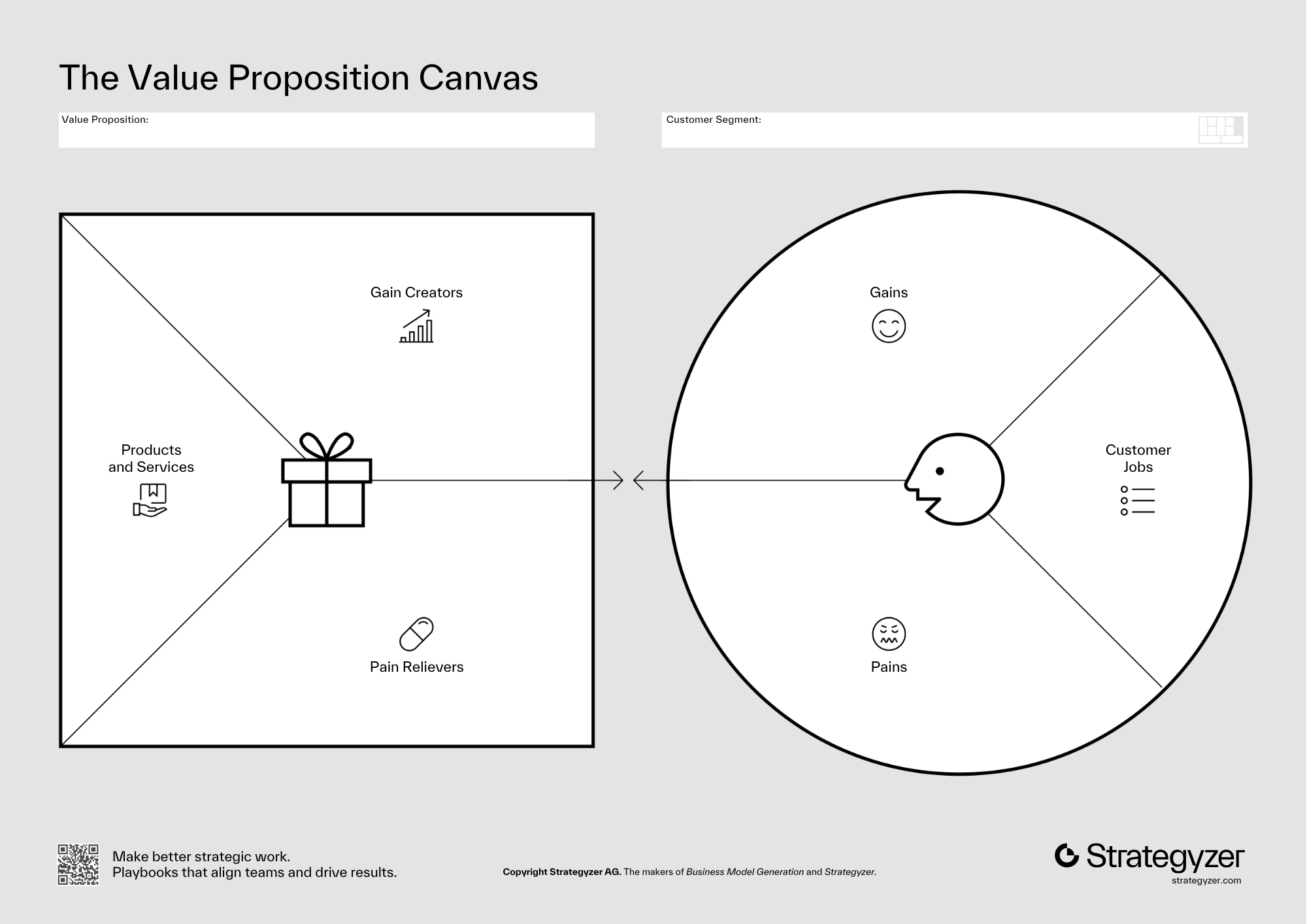
Rather than creating an entirely new framework, we began with the Strategyzer Value Proposition Canvas as a foundation.
However, it soon became clear that the original Canvas did not fully address the complexities of F-Secure’s B2B2C environment, particularly the indirect relationship with end users and the presence of multiple layers of internal and partner constraints.
As a result, the work focused on adapting and extending the existing structure to better reflect the realities of this context.
Insights were drawn from:
• Informal conversations : across product, design, customer care, and partner-facing roles, especially while mapping internal and partner journeys
• Live observations : during co-creation workshops, where participants often surfaced systemic blockers and feasibility constraints while ideating
• Heuristic thinking : in workshop settings, where assumed consumer needs and partner demands were structured and tested in real time
• Internal critique sessions : where early Canvas iterations were reviewed by the design team, leading to ongoing refinements
Through this reflective, embedded approach, two new types of insight were defined:
• Pressures : internal or partner-side challenges that made it difficult to deliver on consumer needs
• Best Behaviors : the ideal consumer behaviors that the solution should encourage over time
These additions helped expand the scope of insight beyond external customer data to include internal dynamics and strategic direction, both essential in layered, multi-stakeholder environments like F-Secure’s.
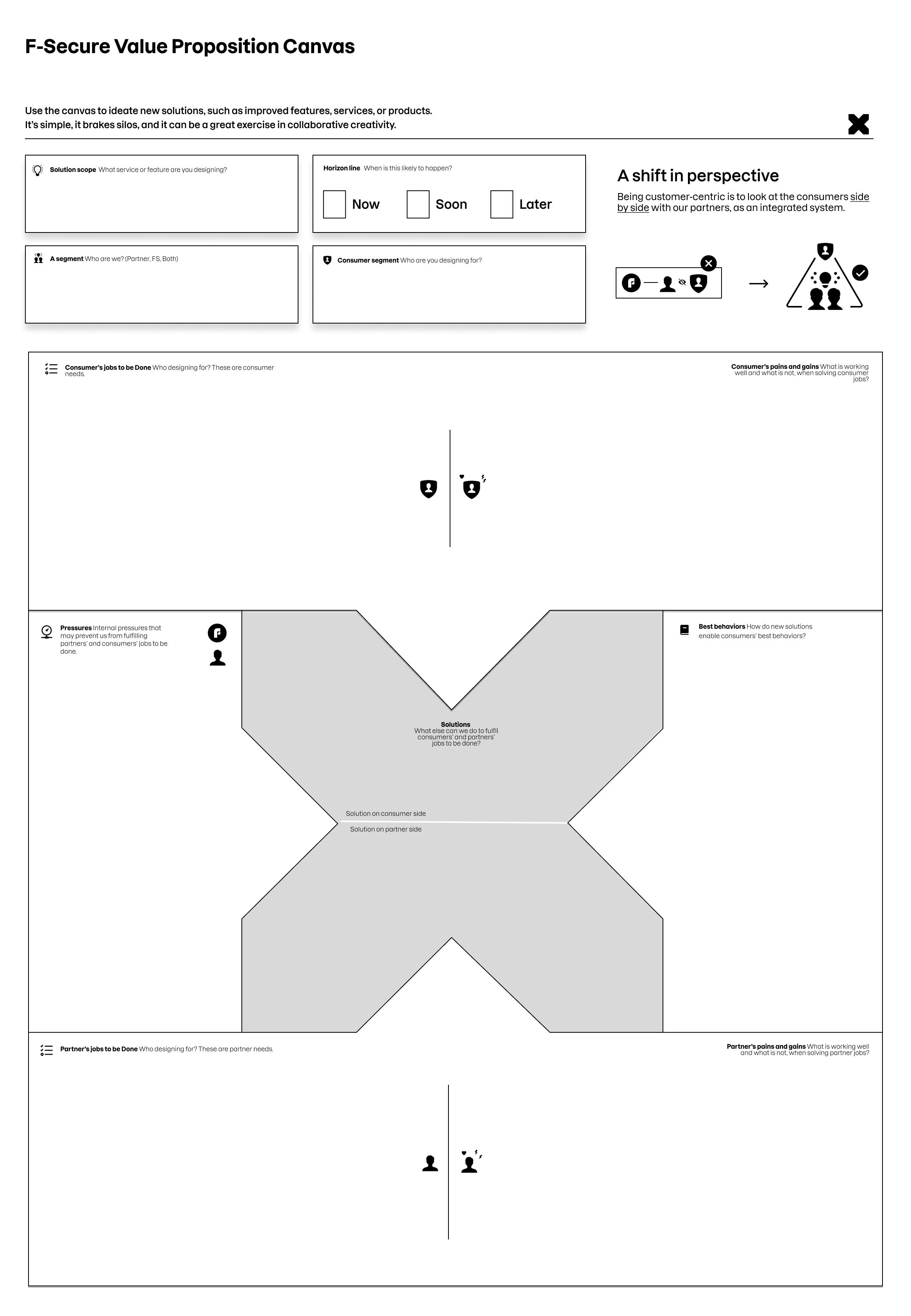
Strategyzer Value Proposition Canvas First version of our custom-designed Canvas
Tools, Methods, and Co-Creation Practice
Two main co-creation workshops were used to test the first version of the Canvas:
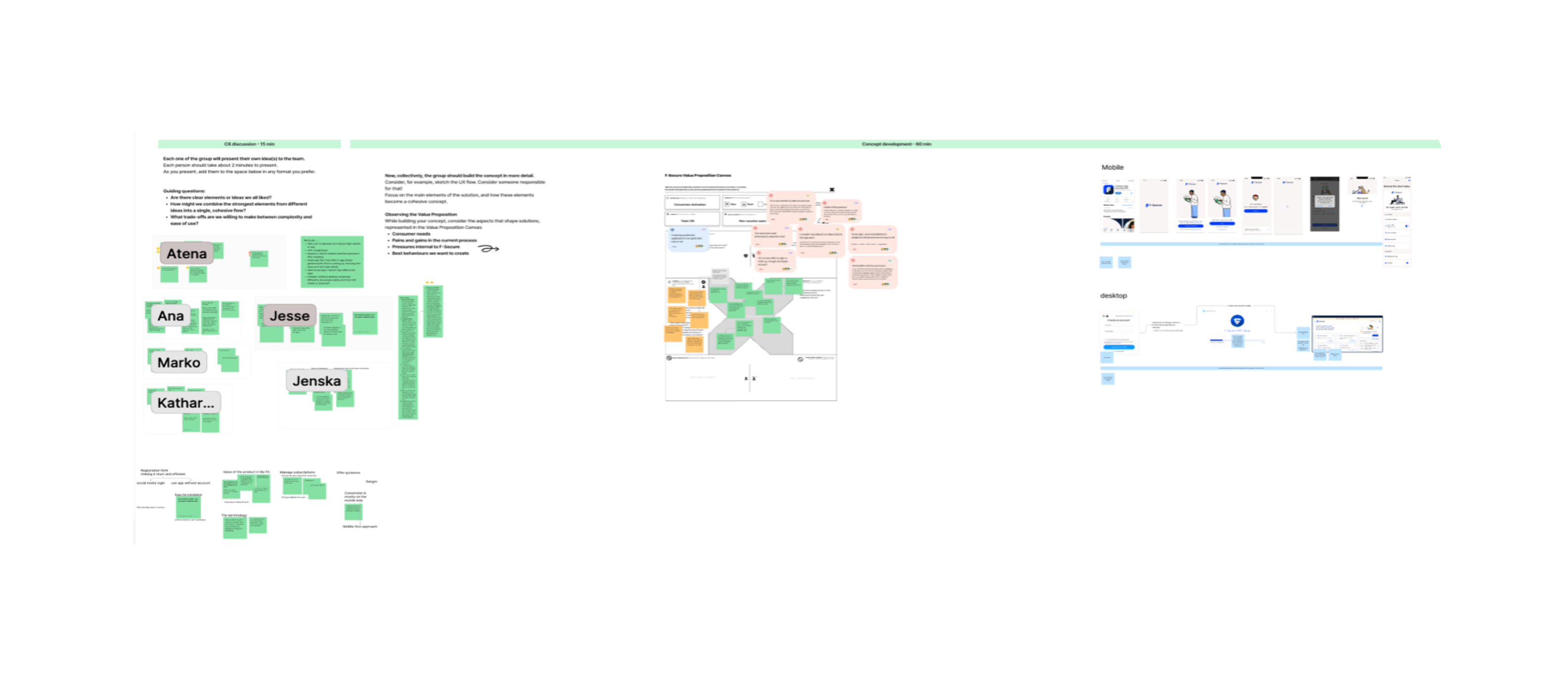
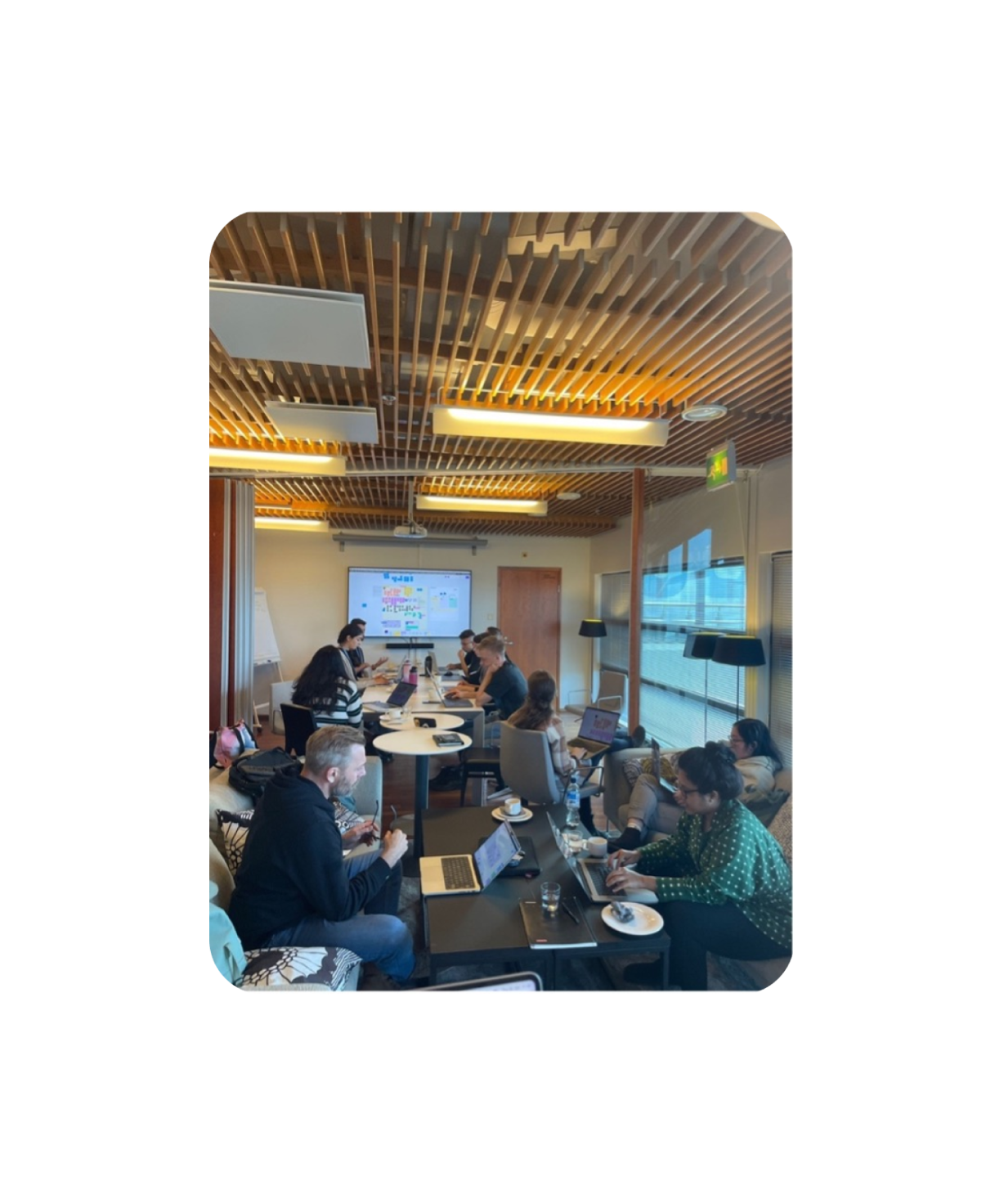
1. Workshop 1 focused on addressing a long-standing consumer pain point sourced from customer care data. Around 15 participants from the Direct Business team worked through current journey flows, mapped pain points to unmet needs, and ideated solutions. Designers facilitated discussions using the Canvas and recorded internal blockers as “pressures” in real time.
2. Workshop 2 involved 12 designers working on a feature enhancement scenario, requested by one of the partners, without validated consumer insights. The group relied on heuristic thinking and assumptions. Despite the lack of concrete data, the Canvas helped structure thinking and force a return to customer context.
Both workshops applied service design methods, including Journey mapping, Crazy 8s ideation, Insight clustering and assumption mapping, Canvas-based collaborative framing in Figma, Real-time concept sketching with UX designers.
Our messy brainstorming in Figma during Workshop 1
The Canvas evolved between sessions. Key refinements included:
1. Adding an “Opportunity” field to frame each Canvas around a focused scope
2. Replacing partner insights with Partner Pressures to avoid redundancy and shift focus toward the delivery context. (Please check out the initial version and final version of Canvas in the Visual Document.)
3. Adding a “User Story” field to maintain consumer focus across the solution lifecycle
3. Introducing “Early Acceptance Criteria” as a lightweight outcome framing to support handoff into development
Workshop 2
Why This Approach Was Used
The approach was reflective and iterative, grounded in cross-functional collaboration and aligned with F-Secure’s ongoing adoption of the Triple Diamond process as a customer-centric design framework. Rather than applying a theoretical model in isolation, the Canvas was designed to support that transition by helping teams in several key ways:
• Framing opportunities based on consumer insights
• Making internal and partner pressures visible early
• Guiding early solution concepts toward long-term behaviors
• Improving alignment between design, product, and development
By making insights, constraints, and best behaviour visible on a shared canvas, teams could frame solution concepts with a deeper understanding of both customer value and organizational realities. This helped bridge common gaps between strategy and delivery, particularly where consumer needs, partner demands, and internal pressures intersected.
The Outcome
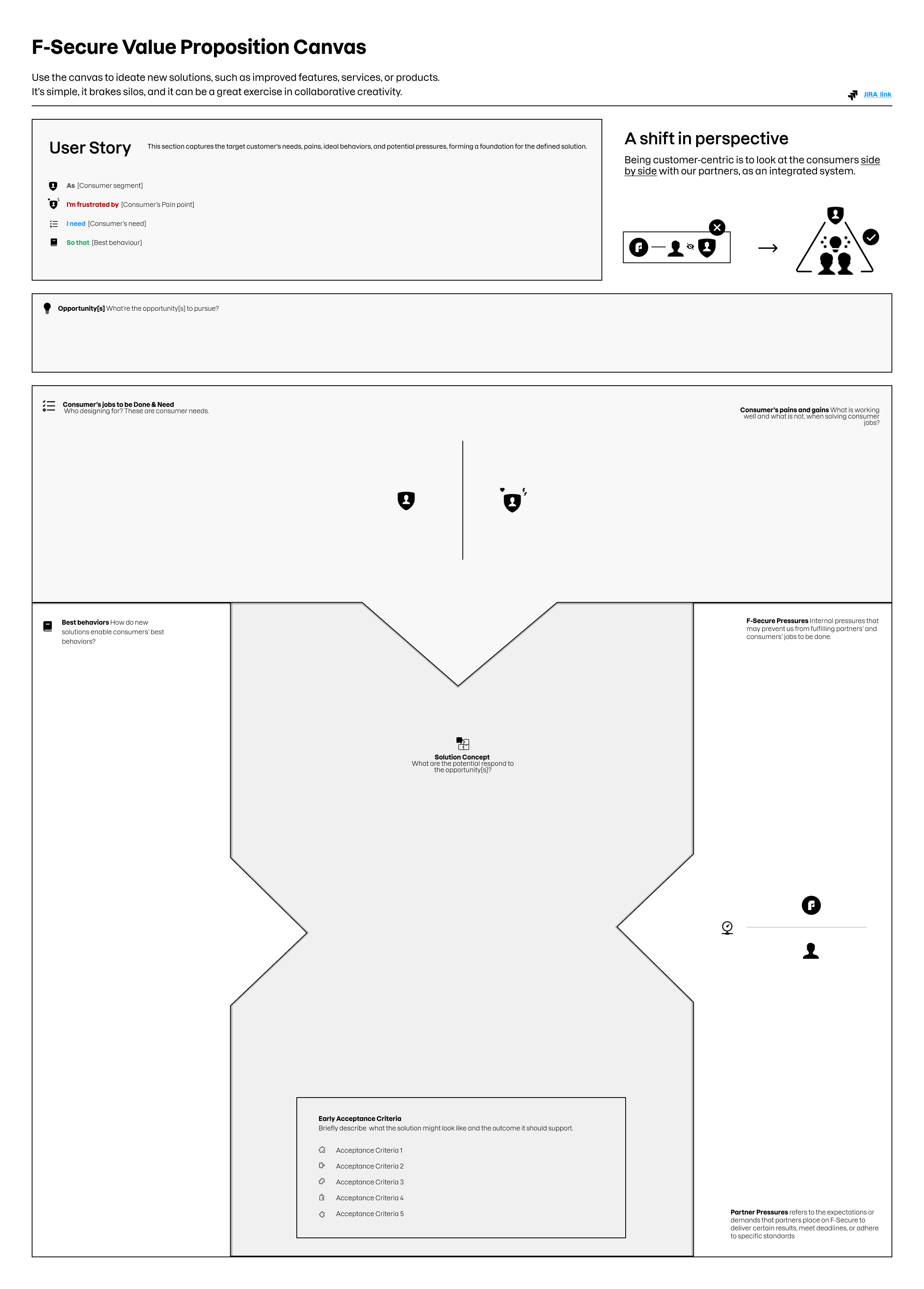
The outcome of this project was a refined and context-specific Value Proposition Canvas, adapted to F-Secure’s complex B2B2C environment and aligned with the Solution Discovery phase of the Triple Diamond model. The Canvas evolved through iterative use and reflection, and introduced several structural innovations not present in the original Strategyzer version:
• Opportunity field to scope each Canvas around a single insight-driven problem space
• User Story to anchor the design in a specific user need and behavior
• Pressures (internal and partner) to make invisible constraints visible in early solution framing
• Best Behaviors to express the ideal future state and guide long-term strategic alignment
• Early Acceptance Criteria to help shape a clear outcome and ease handoff into development
These changes helped the Canvas become not just a mapping tool, but a facilitation framework that encouraged cross-functional alignment around meaningful, feasible, and future-oriented solution concepts.
Final version of our canvas
Integration Into Practice
The Canvas is now in use across multiple teams within F-Secure’s design function. It’s becoming part of the company’s toolkit for Solution Discovery and is increasingly adopted in early-stage framing conversations between design, product, and engineering.
Scope Limitations
• The Canvas has not yet been tested in external partner-facing workshops
• Longitudinal data on its effectiveness over time is still being collected
The Impact
Although full-scale rollout is still underway, the Canvas is making a meaningful impact on how early-stage solution discovery is approached within F-Secure. It’s contributing to shifting internal practices, supporting alignment, and making customer-centric thinking more actionable in a B2B2C environment.
Before vs. After (Qualitative Shift)
Before
• Solution discovery often began with assumptions or internal priorities
• Partner feedback dominated, while consumer insights were limited or missing
• Teams worked in silos, with unclear shared understanding of opportunity, feasibility, or user context
• Design handoff to development lacked a structured framing of the customer problem
After
• Discussions are now scoped around clearly defined, insight-driven opportunities
• Internal and partner pressures are made visible from the start, leading to more grounded and feasible concepts
• Cross-functional teams align earlier, using shared language and structure
• Early Acceptance Criteria provide just enough framing to support smoother transitions into development
Key Takeaways
For Practitioners:
• Keep your canvas focused on one clearly framed opportunity
• Make internal and partner pressures visible early
• Foster cross-functional collaboration early in the process to surface different perspectives and build shared understanding
For Organizations:
• Cross-functional alignment and intentional use of customer-centric processes are essential to embedding long-term change
• Strategic shifts toward customer-centricity must be translated into practical tools for teams to work differently
• Designing value requires designing the conditions that allow value to emerge — including visibility of pressures, behaviors, and stakeholder roles