- 2 April, 2026
- By Atena
The blockers your team feels? Your customers feel them too
Internal and customer pain aren't separate problems, they're the same one

Organizations usually have the customer insight: research has been done, the customer needs are understood. But when it comes to solution discovery, other things inside the organization hijack it: internal priorities, constraints, whatever's competing for attention at the time. Not because the customer insight wasn't good enough, It just gets deprioritized once other factors take over.
It gets even messier in complex organizations like B2B2C ones. There are more layers between the organization and the end customer. A business partner (like a telecom operator or an ISP), sits in the middle, bringing its own demands and pressures to the organization on top of whatever's already happening internally.
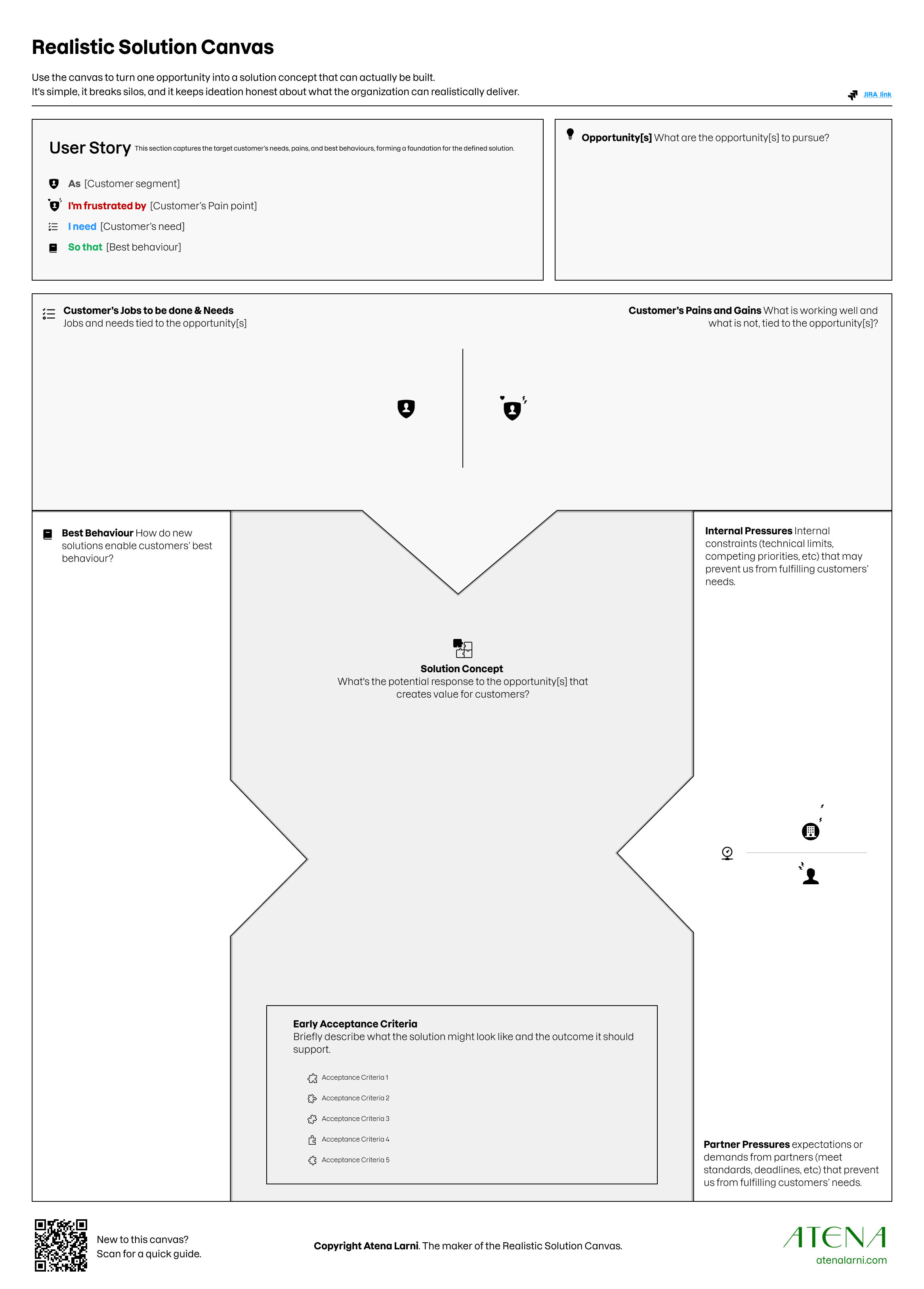
The Realistic Solution Canvas has been inspired by the Strategyzer Value Proposition Canvas, but built for more complex settings (this is an independent work, not affiliated with or endorsed by Strategyzer). It adds what that context needs: a placeholder for internal and partner Pressures, a directional Best Behaviour to aim solutions toward, a focused Opportunity to scope the work, and two lightweight bridges — a User Story and Early Acceptance Criteria — that carry the thinking from discovery into delivery.
It was developed and iteratively tested through co-creation workshops inside a B2B2C customer-centric technology organization, and refined across multiple rounds based on what did and didn't work in practice. This guide is the practical version of that work, how to use the Canvas, not just why it exists.
Scopes the work to one opportunity instead of open-ended ideation. One canvas, one opportunity, one solution concept.
Internal and Partner pain points sit alongside the Solution Concept, forcing the team to name what could actually prevent them from fulfilling customer needs, before it happens, not after.
Anchors the solution to a concrete future state: what should the customer be able to do once this exists, that they can't do now.
Structures the canvas's input and output, bridging discovery to delivery.
• A User Story consolidates the canvas's insights into a concise statement to support handover into design and development.
• An optional Early Acceptance Criteria section under the Solution Concept offers a high-level description of intended outcomes.
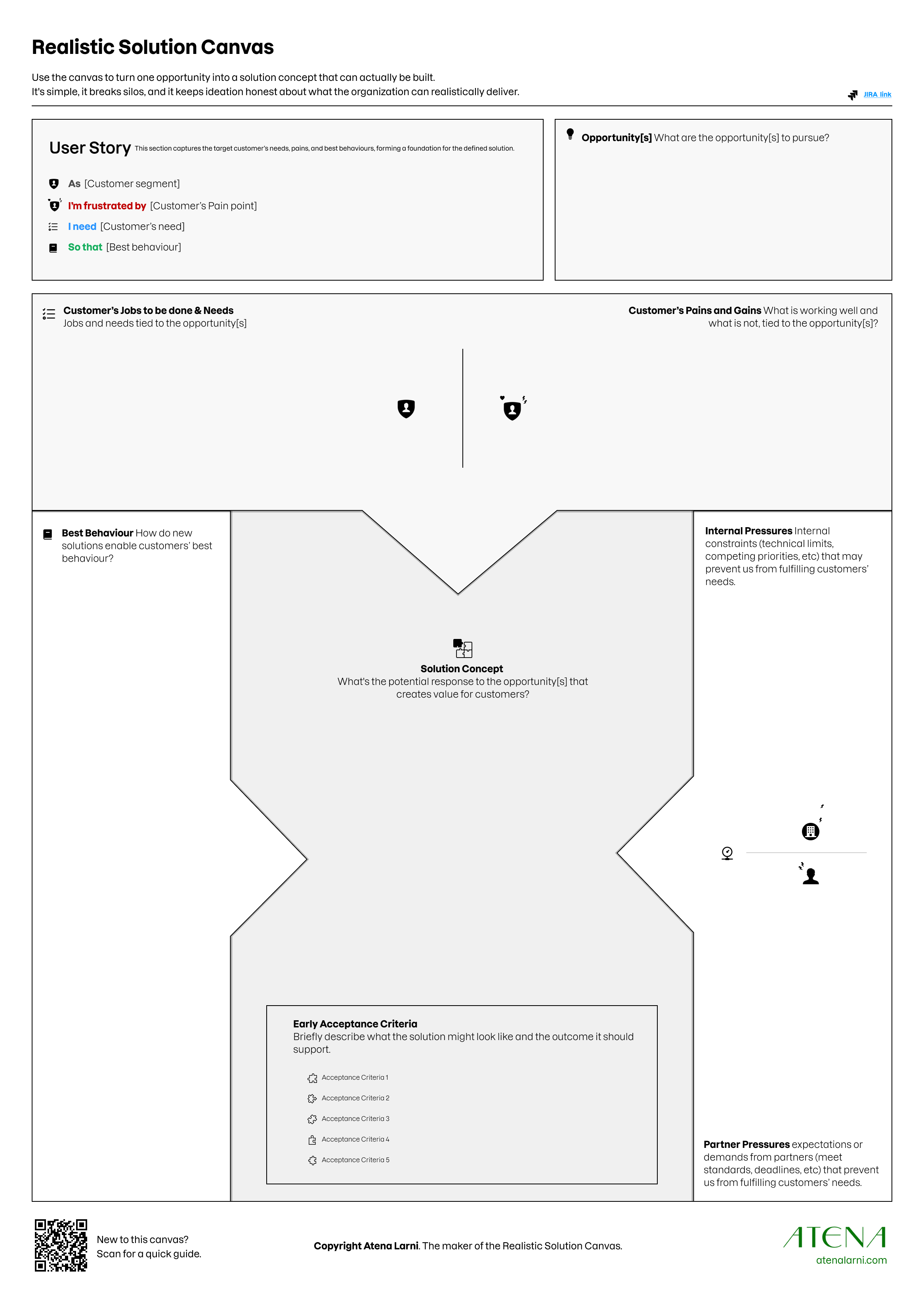
The Canvas can be filled solo as a thinking tool, but it's built for co-creation. Work through it in this order:
| Phase | Step | What it captures |
|---|---|---|
| Before Co-creation | 1. Define the Opportunity | Name the one opportunity you're pursuing. One canvas, one opportunity. |
| 2. Consumer's Jobs, Needs, Pains & Gains | Bring in what's already known from existing customer research, tied to that opportunity. | |
| 3. User Story | Draft a concise statement from that existing insight: the customer segment, their pain, their need, and the behaviour you're aiming for. | |
| During Co-creation | 4. Internal Pressures | Name what inside the organization could get in the way. |
| 5. Partner Pressures | Name what partners expect or demand that could get in the way. | |
| 6. Best Behaviour | Define the future state you want the solution to move customers toward. | |
| End result | 7. Solution Concept | Shape the response together, informed by everything mapped so far. |
| 8. Early Acceptance Criteria | Give a high-level description of the intended outcomes. |
One Opportunity, one Canvas. If a session generates ideas that span several unrelated pain points, that's a sign to split into separate Canvases rather than force everything onto one.
The Canvas only works when it's grounded in actual customer understanding. Used without any consumer input, it still forces a team to slow down and ask the right questions, but treat that as a stopgap, not a substitute for validation.
Sessions limited to a single discipline move fast, but the ideas they produce look conceptually strong and fall apart on contact with feasibility, delivery, or commercial reality. Bring in whoever is responsible for technical feasibility, business viability, and customer desirability (intentionally, not as an afterthought) and match the invite list to the scope of the Opportunity, since some Opportunities cut across several parts of the customer journey and several teams' territory.
A single, clearly defined Opportunity per Canvas is what makes the rest of the exercise manageable. Broad scope is the single most common way these sessions go sideways; insights and ideas pile up with no way to organize or follow up on them.
The Solution Concept is a directional idea, not a finished design. Resist the pull toward user flows, UI decisions, or locked specifications during discovery. That work belongs later, once the concept has been validated.
When a session asks "what does the partner need," the honest answer is usually "they need us to hit a deadline, beat a competitor, or protect revenue" — that's a Pressure, not a need. The consumer stays the end-user the solution is designed for; the partner's role is to enable and distribute that solution, not to be a second customer segment with its own value proposition.
If ideas and insights no longer fit cleanly into the boxes, the scope is too broad — split it rather than force it.
Fast and energizing, but the output needs a feasibility and business-viability gut-check from people who weren't in the room.
If the Solution Concept can't be summarized in a one-line User Story, it likely isn't focused enough yet to hand off.
Before
• Solution discovery often began with assumptions or internal priorities
• Business partner feedback dominated, while customer insights were limited or missing
• Teams worked in silos, with unclear shared understanding of opportunity, feasibility, or user context
• Design handoff to development lacked a structured framing of the customer problem
After
• Discussions are now scoped around clearly defined, insight-driven opportunities
• Internal and partner pressures are made visible from the start, leading to more grounded and feasible concepts
• Cross-functional teams align earlier, using shared language and structure
• Early Acceptance Criteria provide just enough framing to support smoother transitions into development
The Realistic Solution Canvas grew out of academic research on customer-centric transition in B2B2C technology organizations at F-Secure Corporation, presented at NordDesign 2026. It draws on value proposition thinking as a starting point, extended with original elements developed through that research.
Here is the link to relevant publications: Publication 1
The Canvas works best facilitated, not handed off. If you want help running the workshop or adapting it to your organization, reach out.
© 2026. All rights reserved by Atena Larni.